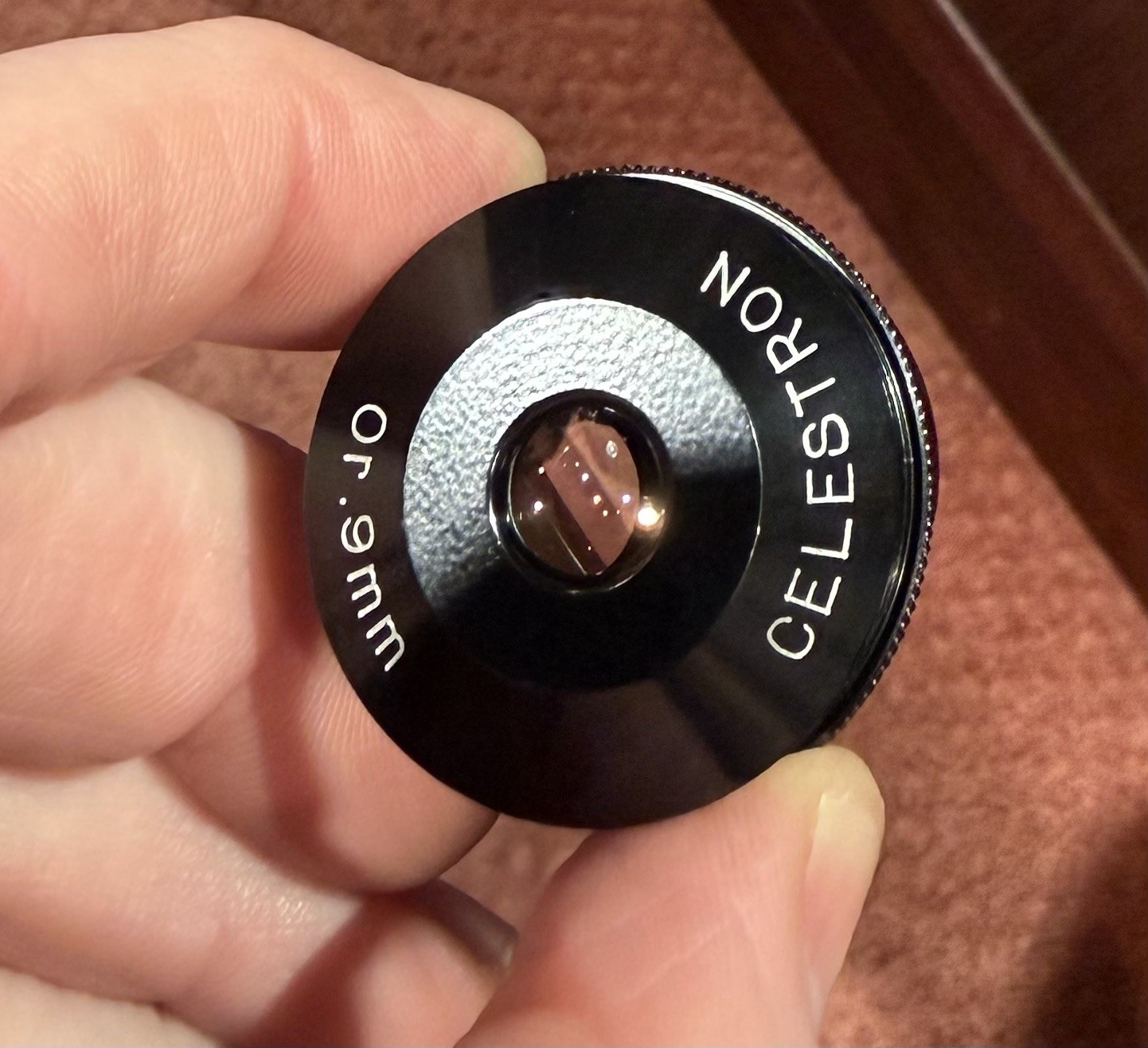
Celestron SP-C80 Super C8 9mm Orthoscopic 1.25" Eyepiece
This original Celestron SP-C80 Super C8 9mm orthoscopic 1.25" eyepiece is offered in collectible excellent cosmetic condition. The chrome barrel shows light hairlines, some plating wear, and a spot where a JTII decal is typically seen, while the black body and knurled grip remain very clean with crisp, vibrant markings. Optics are reported to be clear with no dust, fungus, haze, scratches, pitting, or swirl marks, and no cleaning needed. Free shipping is included. Check the listing for details.







| Location | Veradale US |
| Shipping | Free shipping (check listing for details) |
| Seller |
vlookll-daskineaux
100.0% positive · 2761 feedback
|
| Listing | FixedPrice · Active |
| Start time | 2026-03-19T09:36:36.000Z |
| Compatible Brand | For BRESSER, For Celestron, For Lumicon, For Meade, For Orion, For Pentax, For Vixen Optics, For SVBONY, For University Optics, For Edmund Scientific, For Criterion, For Optical Craftsmen, For Optica b/c, For Takahashi, For Unitron, For Tuthill, For TEC, For APM, For Intes, For LZOS, For TMB, For Kenko, For Stellarvue, For GSO, For Parks, For Cave, For TAL, For Explore Scientific, For Astro-Physics, For Borg |
| Brand | Celestron |
| Series | Super Polaris |
| Type | Orthoscopic/Abbe |
| Item Diameter | 1.25 in |
| Compatible Series | see details in description below |
| Compatible Model | will work in any 1.25-inch focuser or diagonal, will cooperate VERY WELL in a 2x barlow |
| Telescope Type | Refractor |
| Features | solid milled aluminum and brass construction, this is the very rarely-seen Mizar sourced 9mm, fully coated, noteworthy planetary eyepiece on all accounts in apochromats, amazing on Jupiter, Saturn, Mars, The Moon, Izar, Castor, 114mm f/8 reflectors LOVE this eyepiece for magnification, not an eyeglasses friendly ocular, an outstanding eyepiece to use in your 2x barlows |
| Focal Length | 9mm |
| MPN | 93304 |
| Country of Origin | Japan |
This auction is for a 1979 Celestron (Mizar of Japan) 1.25-inch 9mm orthoscopic eyepiece. Currently this is not arriving with any dust caps. I will do my very best to locate a top dust cap. Either way, rest assured this ocular will be VERY well protected for shipping to your door.**Photos are views through this 9mm orthoscopic. are views in my prized 1997 Tele Vue Pronto at 53x; notice in particular the excellent
color control on the very high surface brightness of the Moon's limb during the 2026 lunar eclipse. The faint hints of
color you do see are traces of the Pronto's doublet ED system. Equally surprising are the final (2) photos. Photo is through a 2006 Orion SkyView Pro 100mm f/6 achromat at 67x and Photo is with the help of a vintage, Meade 2x long barlow at 134x. Notice the lovely, sharp resolution across the entire plane and even in the short achromat, excellent control of that violent fringing. These prove the tight resolving properties we expect to witness in a top class Japanese orthoscopic.**Collectors will be particularly interested in this Celestron orthoscopic as it features the very rarely seen Mizar etching "M" on the chrome barrel. Of all the Japanese optical manufacturing keiretsus to be involved with Celestron, this is one of the rarest you'll see on their eyepieces. In dealing with ALL of the 1.25-inch Celestron orthoscopics, there are (3) primary generations with a sub-generation between the final (2): Those with the etched silver characters that appear on the top bevel near the lens and are upside down, those that are still bevel volcano tops, but has "CELESTRON" in white-painted, bold italic on the side with the rest of the painted characters directly opposite the Celestron logo, and finally the flat tops of the final years in which the painted characters format follows the previous generation. In the (2) sub-generations; the first occurs in the years 1988-1989 in which the ocular is still a volcano top. "CELESTRON" and the model
specifications are etched silver on the same side and arrive in a non-gloss, white box with the label:CELESTRON OCULAR1/1/4" 9mmThese will never show an mpn unless it is the final half-year run in the catalog.The second occurs immediately between the 1990-1991 years in which "CELESTRON" in italics was not painted-on, but rather an elongated decal that was placed directly above the stated focal length. It is also this era that the Celestron Silvertop (Plossl Oculars) now have a black top ring and with the Vixen "V" in red-gloss paint. They are generally only found with inclusive telescopes entering the final years of the Super Polaris mount.It is interesting to know that the line of these orthoscopics began earlier than their larger 1.25-inch siblings. Some of the orthoscopics, like the 5mm, will not experience as many generation shifts. The 25mm, 12mm, and 9mm experience the most.The 9mm orthoscopic will be found in (5) distinct generations that can be identified by viewing the etched or painted characters as seen below. 1st, 2nd, and 3rd gens will be volcano top-shaped with a knurled aluminum grip ring; 4th gens will be an unusual volcano-flat top and still feature the grip ring, whereas the 5th and final generation will be a perfect flat top with no knurled grip ring.The 3rd gen variant is quite rare to come across.Gen 1 (Towa/Carton/Mizar) silver etchingsCELESTRON and then directly opposite Or 2 (Towa) silver etchings that flow together and are not opposing on the bevelCELESTRON Or. 9mm Gen 3 (Vixen/Daiichi Kogaku) silver etchings will appear upside down and straddle the entire bevelC E L E S T R O N 9 mm O R T H O 11/4 Gen 4 (Vixen) white painted, all characters on side of eyepiece, brand and model adjacentCELESTRON 9mm ORTHO 11/4 FULLY-COATED Gen 5 (Vixen) less brilliant white painted, all characters on side of eyepiece, brand and model adjacent)CELESTROn 9mm ORTHO 11/4 FULLY-COATED**5th generation orthos will almost never ever have "(V) JAPAN" etch on the chrome barrel. Instead, just "JAPAN" will occur. 3rd, 4th, and 5th gens will always arrive with (V) top and bottom dust caps**Within these generation changes, the collector may notice changes in the Japanese manufacturer and the box it comes in:1st gen: Towa and Carton. Pale gray boxes with amethyst ink and with black-and-fade orange decals. Mizar. Lime-green boxes with decals. VERY rarely seen. 2nd gen: Towa. Pale gray boxes with amethyst ink. Usually "CELESTRON" is also a thin ink stamp. 3rd gen: Vixen. White boxes with a white label. Boxes are staples. These are rare. Daiichi Kogaku. Lime-green boxes with white decals.4th gen: Vixen. Orange boxes with white labels. These are thick; later years are thinner. Thick box years arrive with the "cyclops" plexiglass pill capsule.5th gen: Vixen. White semi-gloss boxes with white labels. The very final year or so will feature the mpn.With confidence we can profess the 1st (3) generations of orthoscopics ran from at least June of 1973 until December of 1984. The 4th generation then ran from January of 1985 until roughly December 1989. And then the flattops, the 3rd generation of these primary generations, began to emerge in the smaller focal lengths first (9mm and smaller) from January/February 1990 with the very last year of individual purchase options being November 1993; though we still see a few lingering inclusive-to-telescope orthos existing up to fall of 1994 with the GP-C102ED.In all cases, these orthoscopics, including the non-wireless 12.5mm illuminated orthoscopic guiding eyepiece, were always fully coated.Like some of the Plossl Ocular "Silvertops", and especially with the like-years volcano top kellners, these orthoscopics had a limited time, full-family appearances in the catalogs. In most cases, only in certain years were certain focal lengths made available both as individual purchasable oculars AND as telescope-inclusive oculars. In the end, almost never are ALL OF THEM available during the same year; rather the buyer would have to buy what was offered in the current catalog and hope ones of the past became a recurring product offer.We know that the 18mm, 7mm, and 25mm were the most common; although the 25mm experiences several hiatuses. The 5mm and the 4mm will always be rare. The 12.5mm (not the illuminated guiding eyepiece) is exceptionally rare and many will not recite them to exist, though they indeed did.Unlike the Silvertops, however, there is a longer period in which one could amass the whole set by buying the eyepieces.In total, exactly (10) focal lengths make the entire family, should we choose to intermix all generations:25mm (early C4.5, very early C14, then C14 again in 1990, 2nd gen C8, 2nd gen C5, earliest C-80)18mm (SP-C80, Firstscope 80, SP-C6, SS80, very early C11, and Comet Catcher)12.5mm (very rare and only around for 1 year)12mm (early C14 before 2-inch oculars became inclusive, 2nd gen C5)9mm 7mm (Super C8s and the most of the Ultima 8s)6mm (early C14 before 2-inch oculars became inclusive)5mm4mm8.4mm-21mm ZoomAs stated earlier, there is almost never a specific moment in time where the entire set can be acquired via an order form. Breaking down the timeline of availability is the easiest way to illustrate. Note that IN PARTICULAR WITH the 25mm, after 1987, the only way to get it was with the C14 or the very few, fortunate C4.5s that dodged the 20mm kellner.1973-1977: 25mm, 18mm, 12mm, 9mm, 6mm1978-1980: 12mm, 9mm, 6mm, 5mm, 4mm1981-1987: 25mm, 18mm, 12mm, 9mm, 7mm, 6mm, 5mm, 4mm, zoom1988-1990: 25mm, 18mm, 12.5mm, 12mm, 9mm, 7mm, 6mm, 5mm, 4mm, zoom1991-1992: 25mm (very rare only C4.5) 12.5mm (not after summer), 12mm, 9mm, 7mm, 6mm, 5mm, zoom1993: 25mm (only with C4.5 if you’re lucky) 12mm, 9mm, 6mm1994: 12mm if purchasing the GP-C102ED By 1994, we no longer see the orthoscopics and now make way for the upcoming, Taiwanese-manufactured "Halloween" plossls.Barrel size: 1.25-inchDesign: 4-element orthoscopic (3)(1) configurationOptics: fully coatedField of view: 40 degreesEye relief: 7mmExit aperture: 4.8mmThreaded for filters: yesMaterials: milled anodized aluminum, milled brass, glassWeight: 2.3 ouncesThe 9mm is particularly interesting when considering the 1990-1991 run; it will have the same mpn code as that of the "Cross Hair Eyepiece 1 1/4"; 93304. This occurred because Celestron reassigned the code AFTER summer of 1993 when this 9mm orthoscopic would be forever discontinued. For those of you wondering what the Cross Hair Eyepiece was; this is an all-black milled aluminum 20mm kellner with a cross hair mounted just behind the bottom element. This was the VERY SAME 20mm Kellner many of us would receive with our early-years C4.5 (unknowingly missing out on the legendary 25mm orthoscopic!), except they did not have the cross hairs.The 9mm was one of the longest-living of the orthoscopic ocular family. It, the 12mm and the 6mm living an uninterrupted availability from 1973 until 1993; meaning the 9mm was always available to the customer. Only the 12mm may claim the absolute longest lifespan as it was still being offered as an inclusive-to-telescope eyepiece halfway through 1994.Of the "non-inclusive" members of this eyepiece family, it is the most popular and makes occasional surfaces to the prospecting collector far more frequently than the 5mm, and 4mm. Many consider it to be the threshold high power ortho before the exit aperture becomes frustratingly restrictive due to the inherent properties of these types of element arrangements. As with any planetary class eyepiece 10mm or smaller, this 9mm should be reserved for your exceptionally good-seeing nights (stars like Arcturus, Canopus, Rigel, and Vega are not twinkling) and your upper-shelf telescopes that have excellent figures on the mirrors and lenses and with spot-on collimation. The real good thing here is the 9mm will get you up close and personal to your favorite objects with less fussiness involved. Unlike the widely popular 7mm, though you will still want those sky conditions to be favorable, they will not need to be perfect in order to really see how this classic ortho performs. This ocular is very apt at observation of all things the planets and Moon, and double/triple star systems; particularly when the seeing permits and you may wish to keep the images brighter (smaller than 7mm starts to introduce noticeably dimness). Jupiter, Saturn, Venus and Mars will look good, but only if the seeing is able to tolerate such magnification. I've plugged this orthoscopic into quite a few of my apochromats and am amazed how sweet the views are. The FS-152sv, C-90F, Unitron 102, and C8 Ultima have given me the most memorable images...all trained on either Jupiter's festoon activities, Mars when it was at opposition for polar cap viewing, and on some of my favorite star systems; Epsilon Lyrae, Castor, Izar, and Regulus.Noteworthy reflectors, like the Celestron C4.5, Meade 826C, Criterion RV-8, and Takahashi Epsilon E-160 will handle this orthoscopic perfectly on those steady nights. And for top-quality cassegrains, like the 1st and 2nd gen Celestron C8, Meade 2120 Silvered Optics Group, Takahashi TSC-225, Orion (Russia) Argonaut 150, and the legendary OTI Quantum 6, this 6mm orthoscopic will give you apochromat views.And at this point in time, we should clearly mention that, unfortunately, even at 9mm, this is NOT an eyepiece for anyone who must wear eyeglasses during telescope time. Eye relief is manageably tight and positioning is straight forward, but still easily managed only by those who can view without optical aid. The problem with eyeglasses and this orthoscopic is you will be lucky to get 30 degrees of the available 40 degrees field of view; and it just won't be fair for you or the eyepiece.This auction ad was completely, organically written by Veradale Mobile Observatory, not an A.I. software device; an actual honest-to-goodness, real human with over 20 years experience with now over 1000 telescopes made from today and all the way back to 1948.Packed with great care.